
How Storyum builds a chapter
Most AI writes forward and hopes it stays coherent. Storyum engineers the structure first — as a graph you can see — then computes the book to it. Here's the whole path on one real chapter, from a blank project to finished, quality-checked prose.
Set up the project

A project is one book. You can start from a one-line idea, a synopsis, or go straight to the StoryGraph. The readiness bar tracks how much the engine has to work with. For this walkthrough we build the plot structure-first, in the StoryGraph.
Engineer the plot in StoryGraph

This is the part no prose-first tool has. You lay the chapter out as nodes (beats, reveals, turns) and connections (the coloured wires — the plot's information, tension and character threads). Each node carries its own knowledge layer: who establishes what, what's revealed and to whom (the reader vs a character), what it requires. That's how you design a mystery — the reader knows the witness is lying before the detective does — instead of hoping the model remembers. Change one node and the whole plot re-derives, coherently.
Build the cast

Every character is a structured entity, not a name in a prompt. The fields that matter — the detective's goal (“find who killed Voss — and decide what the truth is worth”), his flaw, the witness who hides what she saw — become load-bearing for everything the engine writes. Grounded entities → coherent scenes.
Place & world

The Blue Room (a rain-slick club with a body out back), Harbor City (a 1940s-style noir port) and its after-dark culture (loyalty to whoever kept you alive) give the prose a real place and real rules to honour — not generic wallpaper.
Lock the canon

Canon facts are the consistency contract: Mara saw the killing but denies it; Sable killed Voss to protect her — a late reveal. Marked HARD/SOFT and scoped, they keep the book from contradicting itself — and let you time a reveal on purpose.
Compute the structure

From the graph the engine derives the chapter: its goal, the ordered key events, the tension curve, and how it breaks into scenes. You didn't type this — it's computed from the structure you built, so it already carries your intended plot.
Check the beats

Every scene expands into ordered beats you can read against your intent — the pawn ticket pocketed “off the books”, Mara's flinch at Voss's name that only the reader catches. Fix any drift here, before the engine spends a word on prose. This is the fidelity checkpoint.
The scene blueprint

Before any prose, each scene is a compact, structured blueprint: who's in it, where, the emotional shift, and the ordered events the render must hit. Verify it matches the scene you meant, and the prose inherits that fidelity.
The story bible
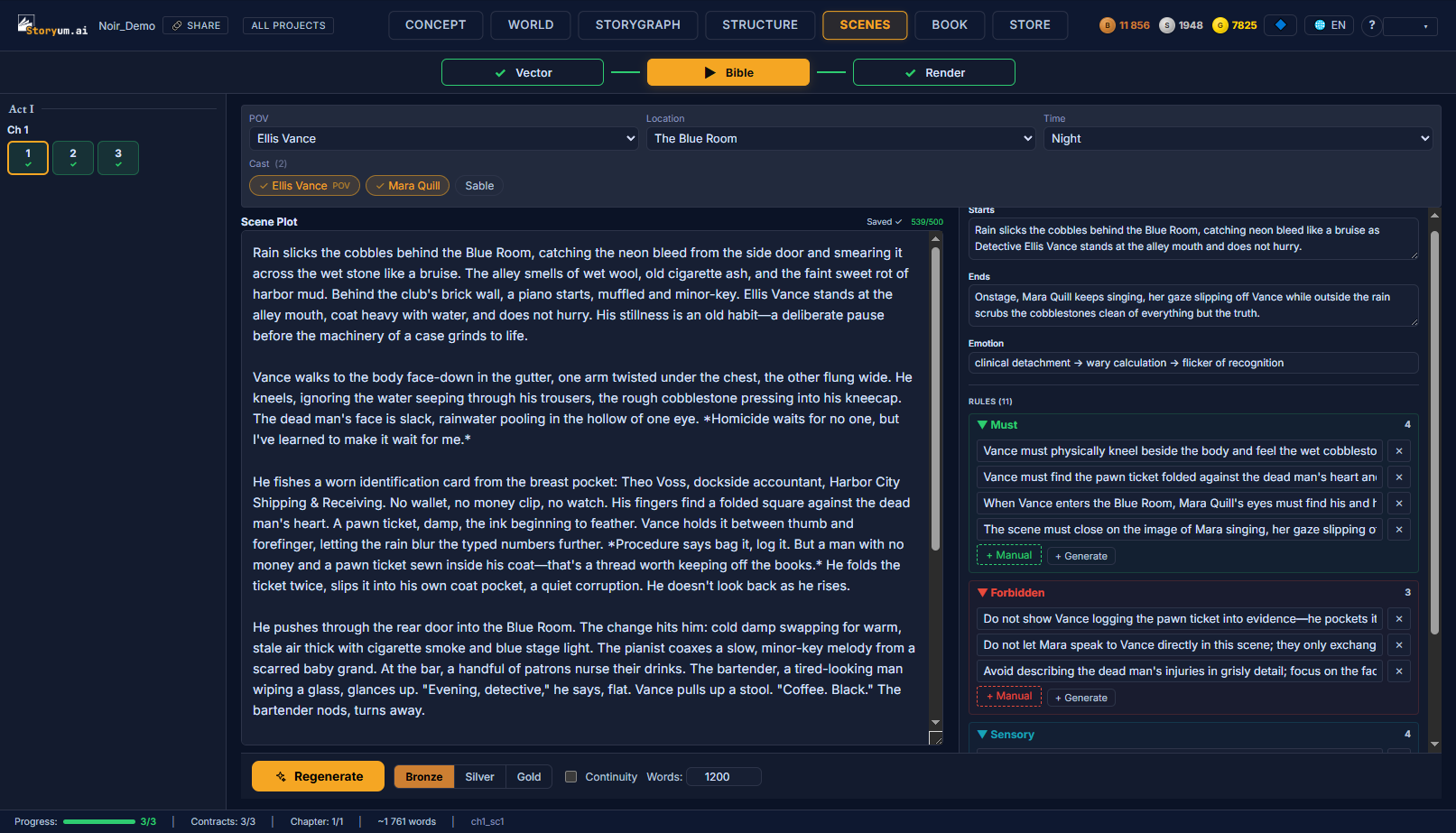
The bible turns the blueprint into rules the render must obey: Vance must find the pawn ticket over the dead man's heart; do not reveal Sable's protective motive yet; the scene's smells and its emotional arc (clinical detachment → wary calculation → a flicker of recognition). This is how coherence is enforced, not hoped.
Render, then prove it's clean
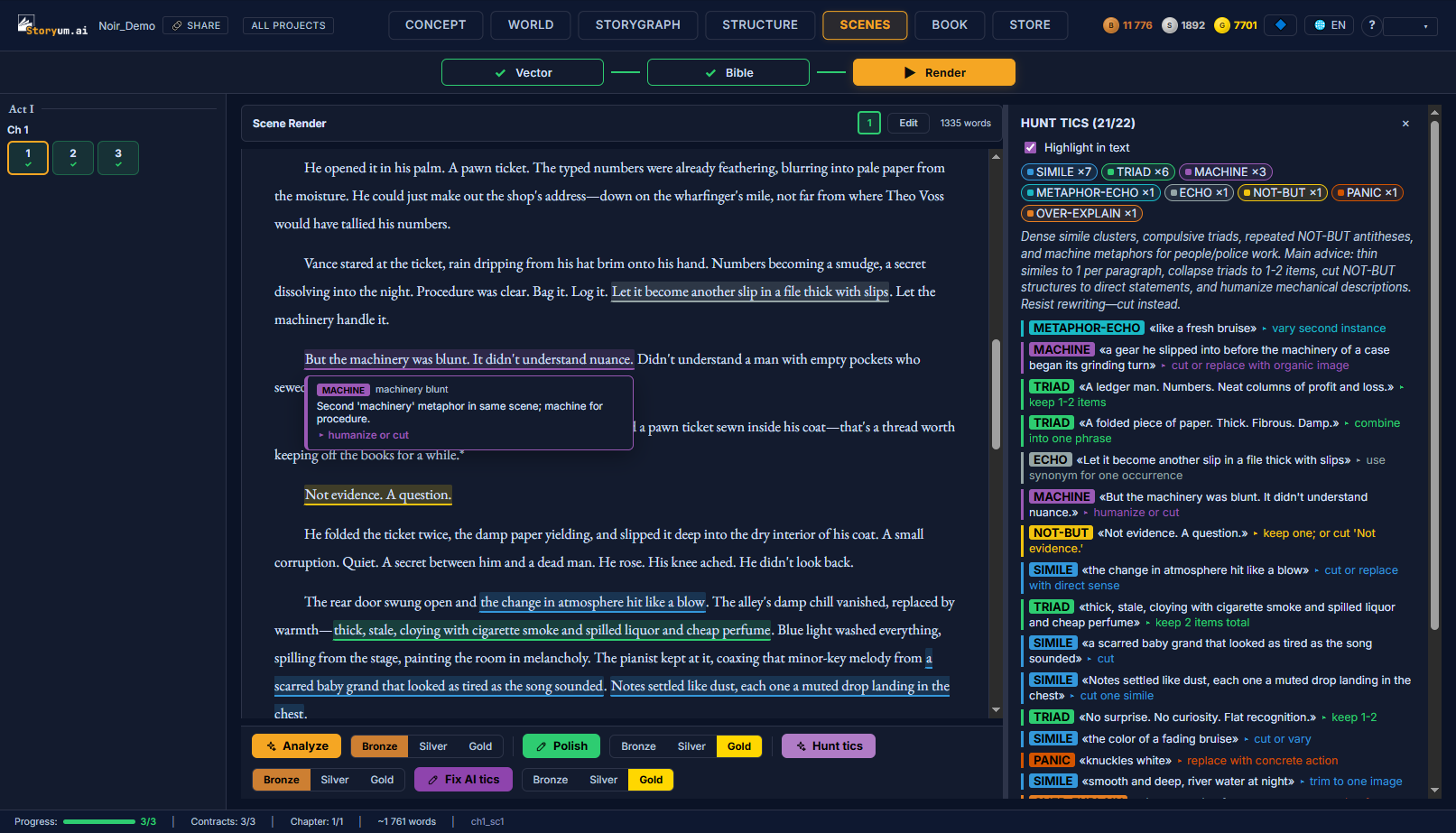
The engine renders the prose to the bible, then measures it: a 10-axis analysis(plot logic, character, style, pacing, continuity…) and an AI-tic hunter that flags the machine-writing tells — dense similes, triads, mechanical metaphors — with a fix for each. Most AI prose reads like AI; this is scored, hunted and cleaned so it reads like you.
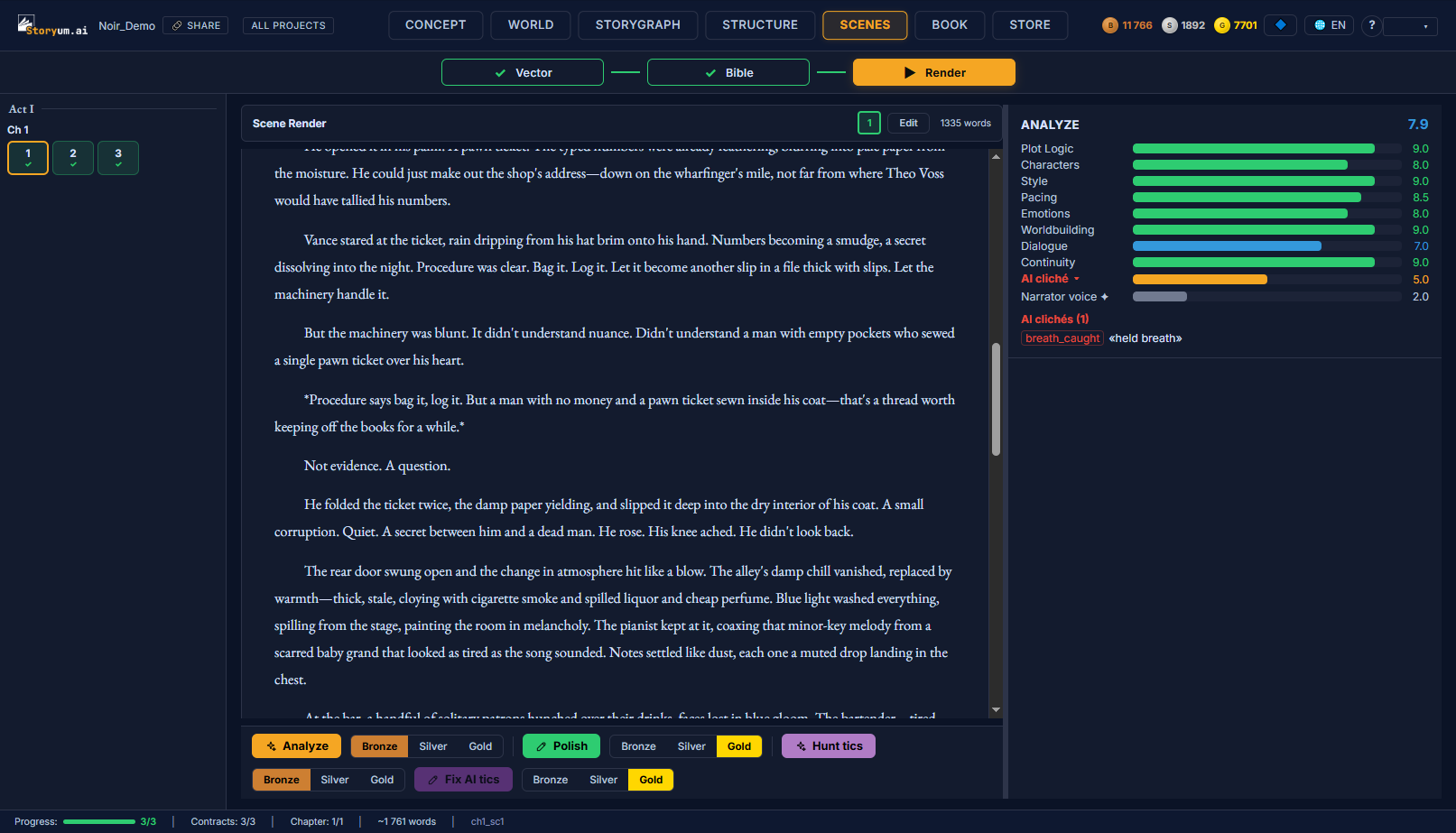
The result
Here's the payoff of the whole pipeline — the engine's own prose for the opening scene, rendered to the structure above and cleaned of AI-tics:
The rain had stopped, but the alley held it. Water slicked the cobblestones behind the club, catching the bleed of blue neon from the side door and smearing it across the wet stone. Wet wool, old cigarettes ground into cracks, the faint sweet rot of harbor mud — the air carried all of it. Ellis Vance stood at the alley mouth, not moving. His coat, heavy with water, pulled at his shoulders. He didn't hurry. The stillness was an old habit, a pause before the machinery of a case began its grinding turn. The body lay exactly where the uniform said it would be — face-down, one arm twisted under the chest, the other flung wide.
Structure reaches the text
AI writes sentences. Storyum engineers stories. Every stage above fed the next; the plot you engineered in the graph is the plot that reached the page — the twist, the timed reveal, the detective's impossible choice, all intact. That's the moat: structure reaches the text.