Characters are the deepest block in Storyum — one character carries 81 fields across 14 sections, from a one-line name to a full psychological and narrative profile. You never have to fill them all: a handful of core fields is enough to start, and the rest let you tighten how a character is written when you want more control. This page documents every field — what it sets, and honestly what it affects.
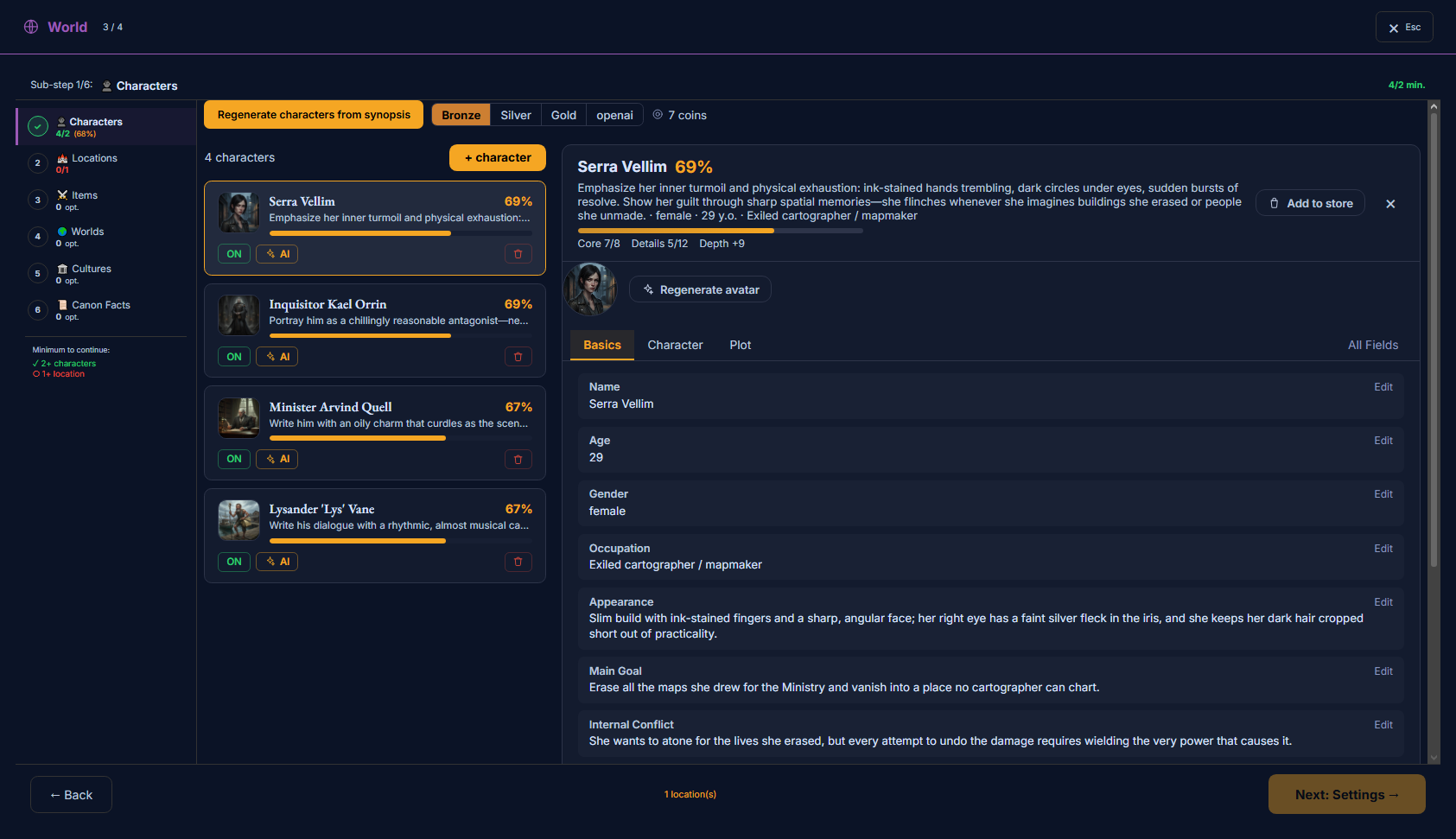
The Character editor: pick a character, edit its profile across tabs (or “All Fields”).
What’s on this page
A character list — add, enable/disable, delete, and see each one’s completeness %.
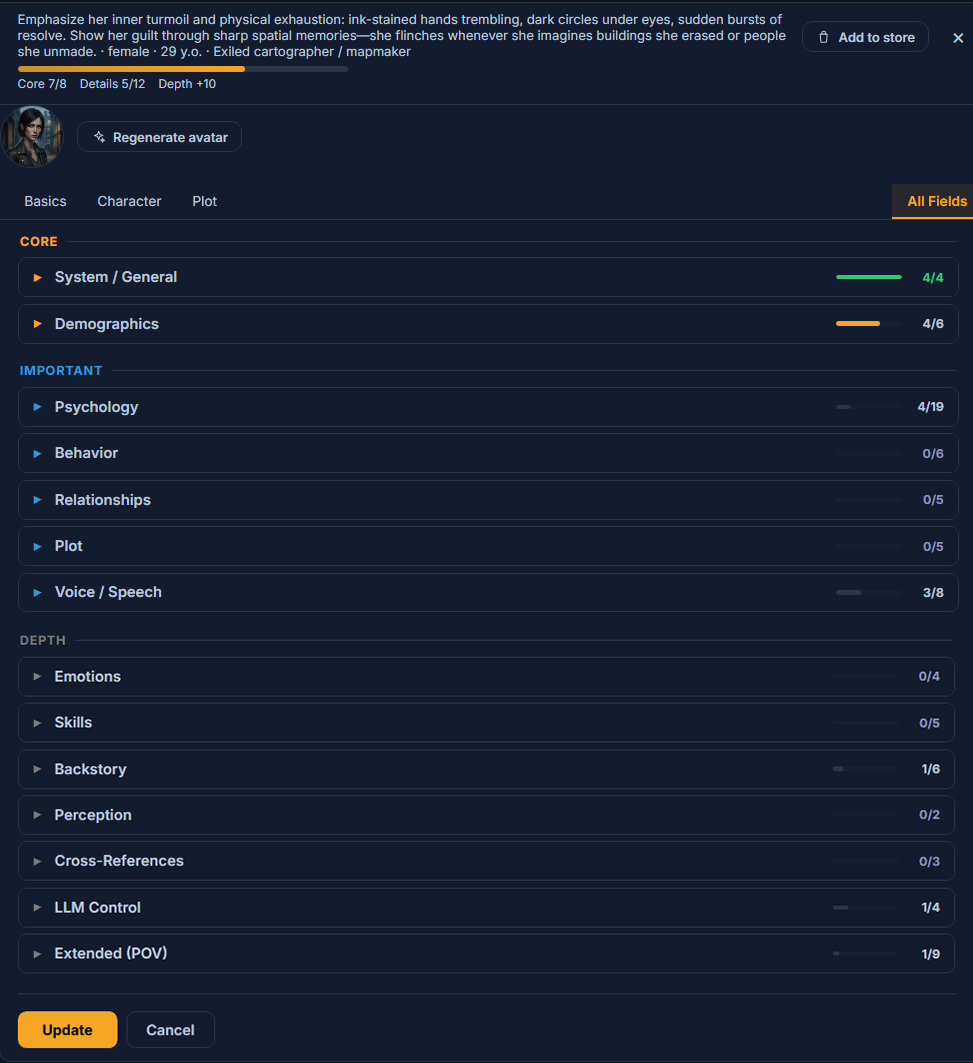
A profile with tabs (Basics · Character · Plot) plus “All Fields” — the full 14-section schema.
“Regenerate characters from synopsis” and per-field AI help (a quality tier + coin cost, or your own key).
A completeness read-out (Core / Details / Depth) that rewards filling the fields that matter most.
How to use it
1Start with the Basics — name, age, gender, occupation, appearance, main goal.
2Add psychology and voice to shape how the character reads; add depth fields only when you want finer control.
3Mark your leads as POV characters — a POV character uses far more of these fields than a background one.
How to read the fields
Each field below lists what it controls and — honestly — what it affects. Not every field changes the prose:
Live — “shapes how the character is written” means it reaches the writer when the character appears. Structural — organizes your project (links, switches) without changing sentences. And a few fields are marked not currently read by the writer — you can fill them, but today they have no effect on the text (we’re reviewing those).
POV vs. background. A point-of-view character uses the full profile; a background cast member uses a smaller core set (name, look, occupation, main goal, flaw, dominant trait, speech and a few more). So the deep psychology and POV fields pay off most on your leads — don’t worry about filling them on a walk-on.
The editor
The right pane edits one character. The Basics · Character · Plot tabs surface the common fields; All Fields opens the full schema, grouped into Core · Important · Depth. The completeness read-out (Core / Details / Depth) rewards filling the fields that matter most first.
“All Fields” — the full 14-section schema, with a fill count per section.
You don’t have to type everything. Regenerate characters from synopsis drafts a whole cast from your synopsis, and many fields have their own AI help. As everywhere, these show a quality tier (Bronze · Silver · Gold) and a coin cost before you commit — or run on your own key (BYOK) at no coin cost.
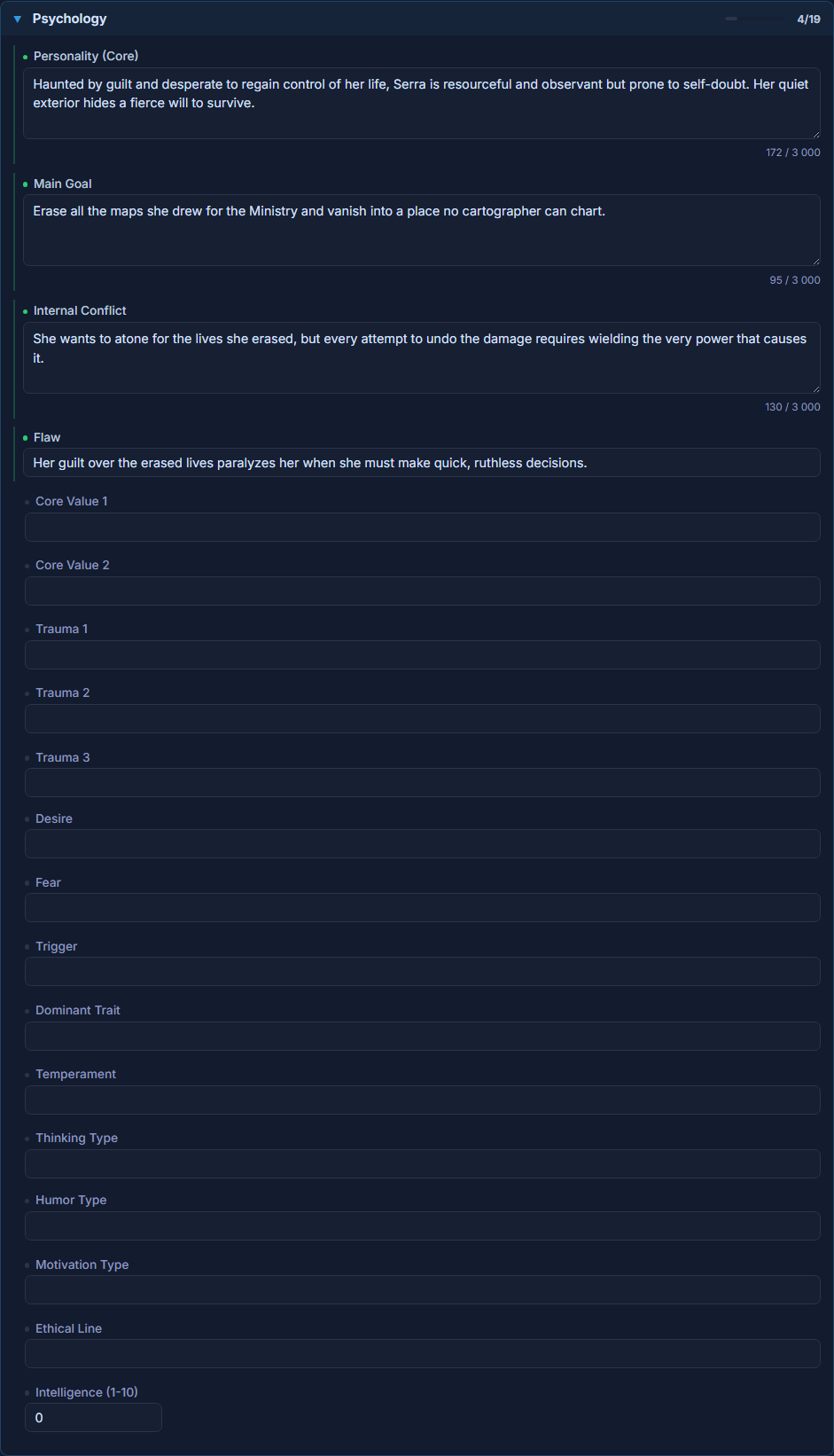
A section expanded — every field is optional; fill what sharpens the character.
Every field
All 81 fields, by section. The Depth sections are advanced — reach for them when you want finer control over a lead.
System / General
Identity and the two switches that decide how the character is used.
Namecanon_name · text
The character’s canonical name.
AffectsShapes how the character is written when they appear in a scene. Also the name the writer must use for them, verbatim.
Use itUse the exact name you want in the prose.
Enabledsys_enabled · toggle
Whether this character is active in the project.
AffectsStructural — organizes your project; it doesn’t directly change the prose. Disabled characters are left out of scenes entirely.
POV Characterchar_is_pov · toggle
Marks the character as a point-of-view character.
AffectsStructural — organizes your project; it doesn’t directly change the prose. A POV character can carry a scene’s viewpoint and uses the full profile; non-POV cast use a smaller core set.
Agecanon_age · number
The character’s age.
AffectsShapes how the character is written when they appear in a scene.
Demographics
Genderdemo_gender · select
The character’s gender.
AffectsShapes how the character is written when they appear in a scene.
Options
male
female
other
Appearancedemo_appearance · textarea
How the character looks.
AffectsShapes how the character is written when they appear in a scene. The writer draws physical description from here.
Use itA few concrete, distinctive details beat a long list.
Occupationdemo_occupation · text
What the character does.
AffectsShapes how the character is written when they appear in a scene.
Social Classdemo_social_class · text
The character’s social standing.
AffectsShapes how the character is written when they appear in a scene.
Ethnicitydemo_ethnicity · text
The character’s ethnicity.
AffectsShapes how the character is written when they appear in a scene.
Educationdemo_education · text
The character’s education.
AffectsShapes how the character is written when they appear in a scene.
Psychology
The inner life — the richest section, and where most of a character’s voice comes from.
Personality (Core)personality_core · textarea
Key personality traits in a sentence or two.
AffectsShapes how the character is written when they appear in a scene.
Use itThe single most useful field after the basics — keep it sharp.
Main Goalpsych_main_goal · textarea
What the character is driving toward.
AffectsShapes how the character is written when they appear in a scene. A core field used even for background cast.
Internal Conflictinternal_conflict · textarea
The inner contradiction that pulls them two ways.
AffectsShapes how the character is written when they appear in a scene.
Flawpsych_flaw · text
The main weakness that creates problems.
AffectsShapes how the character is written when they appear in a scene. A core field used even for background cast.
Core Value 1psych_core_value_1 · text
A guiding value.
AffectsShapes how the character is written when they appear in a scene.
Core Value 2psych_core_value_2 · text
A second guiding value.
AffectsShapes how the character is written when they appear in a scene.
Trauma 1psych_trauma_1 · text
A formative wound.
AffectsShapes how the character is written when they appear in a scene.
Trauma 2psych_trauma_2 · text
A second formative wound.
AffectsShapes how the character is written when they appear in a scene.
Trauma 3psych_trauma_3 · text
A third formative wound.
AffectsShapes how the character is written when they appear in a scene.
Desirepsych_desire_1 · text
What the character wants.
AffectsShapes how the character is written when they appear in a scene.
Fearpsych_fear_1 · text
What the character fears.
AffectsShapes how the character is written when they appear in a scene.
Triggerpsych_trigger · text
What sets the character off.
AffectsShapes how the character is written when they appear in a scene.
Dominant Traitpsych_dominant_trait · text
The one trait that leads.
AffectsShapes how the character is written when they appear in a scene. A core field used even for background cast.
Temperamentpsych_temperament · text
The character’s temperament.
AffectsShapes how the character is written when they appear in a scene.
Thinking Typepsych_thinking_type · text
How the character reasons.
AffectsShapes how the character is written when they appear in a scene.
Humor Typepsych_humor_type · text
The character’s sense of humor.
AffectsShapes how the character is written when they appear in a scene.
Motivation Typepsych_motivation_type · text
What kind of motivation drives them.
AffectsShapes how the character is written when they appear in a scene.
Ethical Linepsych_ethical_line · text
The line the character won’t cross.
AffectsShapes how the character is written when they appear in a scene.
Intelligence (1–10)psych_intelligence · number
An intelligence rating.
AffectsShapes how the character is written when they appear in a scene.
Behavior
Speechbehav_speech · textarea
How the character speaks and behaves in dialogue.
AffectsShapes how the character is written when they appear in a scene. A core field used even for background cast.
Clothingbehav_clothing · text
How the character dresses.
AffectsShapes how the character is written when they appear in a scene.
Gesturesbehav_gestures · text
Characteristic gestures.
AffectsShapes how the character is written when they appear in a scene. A core field used even for background cast.
Behavior Under Stressbehav_stress · text
How the character acts under pressure.
AffectsShapes how the character is written when they appear in a scene. A core field used even for background cast.
Hobbiesbehav_hobbies · text
What the character does for themselves.
AffectsShapes how the character is written when they appear in a scene.
Physical Fitness (1–10)behav_physical · number
A fitness rating.
AffectsShapes how the character is written when they appear in a scene.
Relationships
Familyrel_family · textarea
The character’s family ties.
AffectsShapes how the character is written when they appear in a scene.
Allyrel_ally · text
A described ally.
AffectsShapes how the character is written when they appear in a scene.
Enemyrel_enemy · text
A described enemy.
AffectsShapes how the character is written when they appear in a scene.
Romancerel_romance · text
A romantic tie.
AffectsShapes how the character is written when they appear in a scene.
Secretrel_secret · textarea
A secret the character holds.
AffectsReaches the writing through plot planning (kept out of the per-scene profile so it isn’t spilled early).
⚠Held back from the ordinary scene profile on purpose — it’s spoiler-sensitive.
Plot
The character’s arc. Most of this feeds plot planning, not the per-scene profile.
Archetypeplot_archetype · text
The character’s narrative archetype (protagonist, mentor…).
AffectsUsed in plot planning to cast the character into a role; shapes structure more than sentence-level prose.
Arcplot_arc · textarea
How the character changes over the book.
AffectsFeeds the character’s bible profile and plot planning — it shapes the writing, via the arc rather than a single scene.
Symbolismplot_symbolism · text
What the character symbolizes.
AffectsPassed to the writer as a symbolic note when rendering the character’s scenes.
Voice / Speech
How the character sounds. Strong voice fields are the fastest way to make dialogue distinct.
Speech Stylevoice_speech_style · textarea
How they speak — brief/verbose, formal/rude.
AffectsShapes how the character is written when they appear in a scene. A core field used even for background cast.
Speech Style (Detailed)voice_style · textarea
A fuller description of the speaking style.
AffectsShapes how the character is written when they appear in a scene. A core field used even for background cast.
Vocabularyvoice_vocabulary · text
The character’s characteristic vocabulary.
AffectsShapes how the character is written when they appear in a scene.
Catchphrase 1voice_catch_1 · text
A signature phrase.
AffectsShapes how the character is written when they appear in a scene.
Catchphrase 2voice_catch_2 · text
A second signature phrase.
AffectsShapes how the character is written when they appear in a scene.
Catchphrase 3voice_catch_3 · text
A third signature phrase.
AffectsShapes how the character is written when they appear in a scene.
Banned Wordsvoice_banned · text
Words this character should never say.
AffectsShapes how the character is written when they appear in a scene. The writer avoids these in their voice.
Voice Samplesvoice_sample_lines · voice_samples
Sample lines the character might say, per mood.
AffectsUsed as a few-shot voice anchor at render time — the writer imitates these lines. One of the strongest levers on dialogue voice.
Use itA few vivid sample lines do more for voice than paragraphs of description.
Emotions
Advanced
Current Emotionemotion_current · text
The character’s present emotional state.
AffectsShapes how the character is written when they appear in a scene.
Intensity (0–1)emotion_intensity · number
How strong that emotion is.
AffectsShapes how the character is written when they appear in a scene.
Baseline Stateemotion_baseline · text
The character’s emotional default.
AffectsShapes how the character is written when they appear in a scene.
Suppressed Emotionemotion_suppressed · text
What the character holds back.
AffectsShapes how the character is written when they appear in a scene.
Skills
Advanced
Combat (1–10)skill_combat · number
A combat rating.
AffectsShapes how the character is written when they appear in a scene.
Professional Skillskill_professional · text
Their professional competence.
AffectsShapes how the character is written when they appear in a scene.
Talentskill_talent · text
A notable talent.
AffectsShapes how the character is written when they appear in a scene.
Magicskill_magic · text
Magical ability, if any.
AffectsShapes how the character is written when they appear in a scene.
Achilles Heelskill_achilles · text
A defining weakness.
AffectsShapes how the character is written when they appear in a scene.
Backstory
Advanced
The events before the book — put a character’s backstory into these four numbered events.
Event 1backstory_event_1 · textarea
A formative past event.
AffectsShapes how the character is written when they appear in a scene. Put the character’s backstory into these numbered events.
Event 2backstory_event_2 · textarea
A second past event.
AffectsShapes how the character is written when they appear in a scene.
Event 3backstory_event_3 · textarea
A third past event.
AffectsShapes how the character is written when they appear in a scene.
Event 4backstory_event_4 · textarea
A fourth past event.
AffectsShapes how the character is written when they appear in a scene.
Perception
Advanced
Primary Channelperception_primary · text
The sense the character leads with.
AffectsShapes how the character is written when they appear in a scene. Colors how their scenes are perceived.
Filterperception_filter · text
The lens they see the world through.
AffectsShapes how the character is written when they appear in a scene.
Cross-References
Advanced
Links to other entities. These build your project’s relationship graph — they don’t write prose.
Home (Location ID)cross_home · text
A link to the character’s home location.
AffectsStructural — organizes your project; it doesn’t directly change the prose. Adds a “lives at” edge to the relationship graph.
Items (ID)cross_items · text
Links to items the character owns.
AffectsStructural — organizes your project; it doesn’t directly change the prose. Adds “owns” edges to the relationship graph.
LLM Control
Advanced
Direct instructions to the writer for this character.
Plot Rolellm_directive · text
The character’s plot role (protagonist, antagonist, mentor…).
AffectsShapes how the character is written when they appear in a scene. Carried into the character’s profile as a role directive.
Freedom Levelllm_freedom · text
How much latitude the writer has with this character.
AffectsShapes how the character is written when they appear in a scene.
Banned for LLMllm_banned · textarea
Things the writer must never do with this character.
AffectsShapes how the character is written when they appear in a scene. A hard “don’t” carried into the writing.
Mandatory for LLMllm_mandatory · textarea
Things the writer must always honor.
AffectsShapes how the character is written when they appear in a scene. A hard “must” carried into the writing.
Extended (POV)
Advanced
Fine POV controls — most powerful on your point-of-view characters.
Ally IDschar_ally_ids · text
Links to allied characters.
AffectsStructural — organizes your project; it doesn’t directly change the prose. Adds “ally” edges to the relationship graph.
Enemy IDschar_enemy_ids · text
Links to enemy characters.
AffectsStructural — organizes your project; it doesn’t directly change the prose. Adds “enemy” edges to the relationship graph.
Sensory Prioritychar_sensory_priority · text
Which senses lead in this character’s POV.
AffectsShapes how the character is written when they appear in a scene.
Monologue Stylechar_monologue_style · textarea
The texture of their inner voice.
AffectsShapes how the character is written when they appear in a scene.
Metaphor Domainchar_metaphor_domain · text
The imagery their mind reaches for.
AffectsShapes how the character is written when they appear in a scene. Shapes the metaphors used in their POV.
Perception Biaschar_perception_bias · text
How their view of events skews.
AffectsShapes how the character is written when they appear in a scene.
Emotional Baselinechar_emotional_baseline · text
Their emotional resting state in POV.
AffectsShapes how the character is written when they appear in a scene.
Suppressed Emotionchar_suppressed_emotion · text
What their POV holds under the surface.
AffectsShapes how the character is written when they appear in a scene.
Emotional Arcce_arc · textarea
How the character’s emotion moves across the book.
AffectsFeeds the outline/plan for the character’s emotional through-line.
Join the community — questions, feedback, and other writers building novels with Storyum: Discord · Telegram