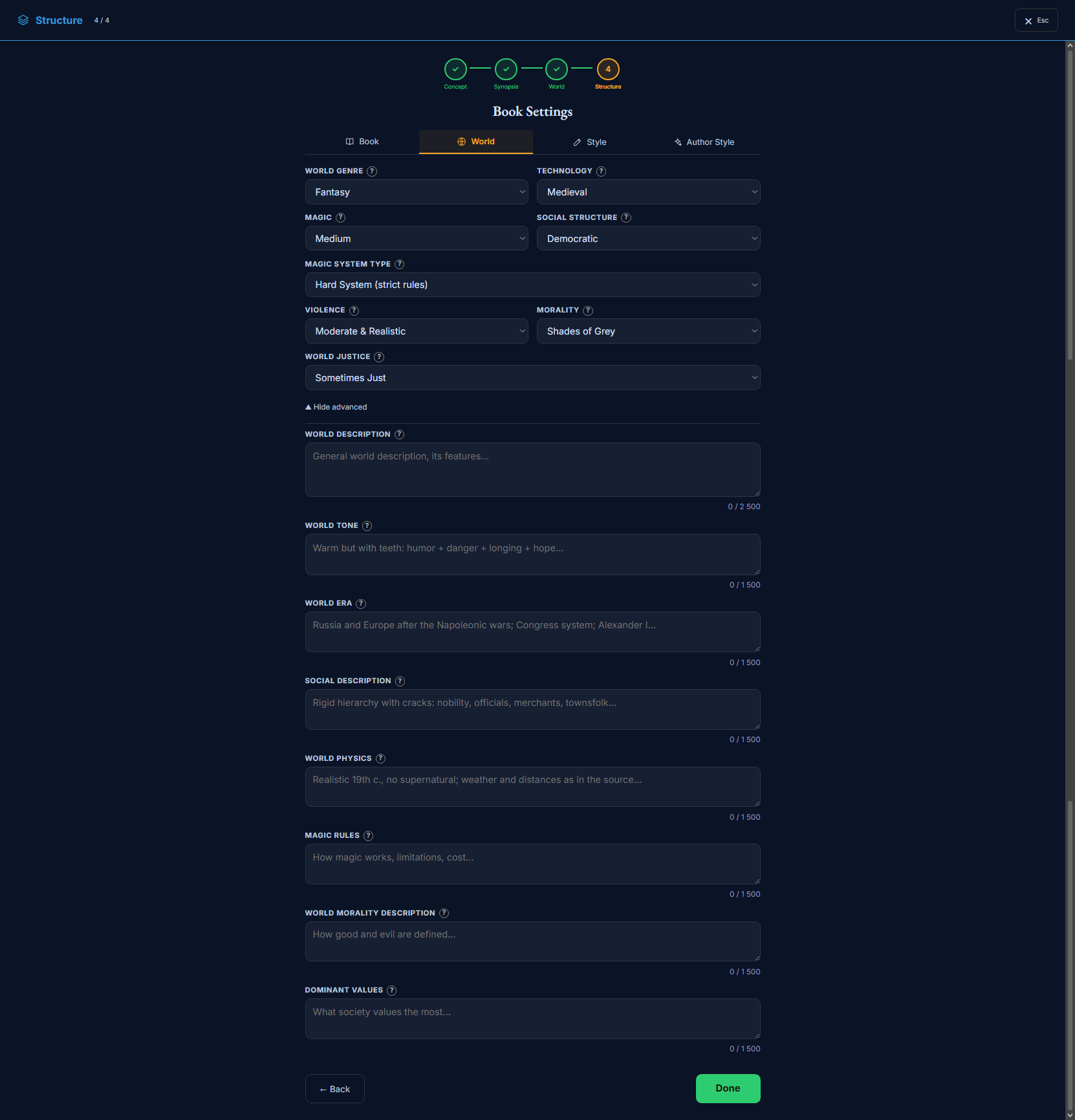
The World tab sets the rules of your setting for the whole book — its genre, technology and magic levels, social order, how violent and how just the world is, and free-text descriptions that ground the writing. It’s the second of the four Book Settings tabs. Think of it as the book-wide “World Rules”: a ruleset every scene is written against, separate from the individual World entities you build in the World step.
Book Settings → World: the book-wide world ruleset, with free-text detail under “Advanced”.
What’s on this page
The world dials: genre, technology, magic (and magic-system type), social structure, violence, morality, and world justice.
An “Advanced settings” drawer of free-text fields: world description, tone, era, social description, physics, magic rules, morality, and dominant values.
Two fields appear only when Magic isn’t “none” — the magic-system type and the magic rules.
How to use it
1Set the dials first — they define the world in one line each and pre-fill sensible defaults from your genre.
2Open Advanced to add the prose that makes the world specific: its era, physics, social texture and values.
3Keep the World genre consistent with the Book tab’s genre — a mismatch raises a validation warning.
Storyum has two things called “world”, and they do different jobs. This World tab sets the book-wide World Rules — one ruleset for the whole book: its genre, tech and magic levels, social order, and the free-text detail that grounds it. The World block in the World step is different: those are individual world entities you can create several of and attach to scenes. The tab here is the backdrop every scene is written against; the entities are specific places in it.
How these reach the book. The World tab’s settings are validated as a ruleset and folded into the scene context the pipeline builds — so they shape what the world can and can’t contain in every chapter. The dials set the hard limits (tech, magic, violence); the free-text fields add the texture.
The World tab, field by field
The dials sit up top; the free-text detail is under “Advanced settings”. Two fields — the magic-system type and the magic rules — appear only when Magic isn’t set to “none”.
The world dials
Each defines the world in one choice. Picking a Book-tab genre pre-fills matching defaults here.
World genrewr_genre · select
The genre of the setting — may differ from the book’s literary genre.
AffectsFed to the writing — part of the book-wide World Rules the pipeline validates and folds into the scene context, so every scene is written to fit the world. It anchors the world’s conventions. It’s cross-checked against the Book tab’s genre.
⚠If the World genre differs from the Book tab’s genre, the pipeline raises a validation warning — keep them aligned unless you mean the mismatch (e.g. a literary novel in a fantasy world).
Technologywr_tech_level · select
The technology level, from primitive to far-future.
AffectsFed to the writing — part of the book-wide World Rules the pipeline validates and folds into the scene context, so every scene is written to fit the world. Bars anachronisms — what tools, weapons and travel the world can show.
Options
Bronze Age / Medieval / Renaissancepre-industrial
Industrial / Victorian / Modern / Cold Warindustrial to contemporary
Near-future / Futuristicspeculative tech
Magicwr_magic_level · select
How present magic is, from none to ubiquitous.
AffectsFed to the writing — part of the book-wide World Rules the pipeline validates and folds into the scene context, so every scene is written to fit the world. Sets whether magic exists at all; “none” hides the magic-system and magic-rules fields.
Options
Noneno magic — the two magic fields disappear
Lowrare, subtle
Mediuma real force in the world
Highpervasive
Social structurewr_social_structure · select
How society is organized — class, hierarchy and governance.
AffectsFed to the writing — part of the book-wide World Rules the pipeline validates and folds into the scene context, so every scene is written to fit the world.
Options
Tribal / Feudal / Imperialpre-modern orders
Democratic / Corporate / Anarchicmodern or speculative orders
Magic system typewr_magic_system · select
The magic typology (separate from level). Shown only when Magic isn’t “none”.
AffectsFed to the writing — part of the book-wide World Rules the pipeline validates and folds into the scene context, so every scene is written to fit the world. Sets how magic feels — lawful and costed, or intuitive and mysterious.
Options
Hard System (strict rules)defined, consistent, costed magic
Soft / Intuitivemysterious, unexplained
Scientific / Technomagic-as-technology
Mystical / Spiritualfaith- or spirit-driven
Folkloricrooted in myth and custom
Violencewr_violence · select
How graphic violence is allowed to be in the prose.
AffectsFed to the writing — part of the book-wide World Rules the pipeline validates and folds into the scene context, so every scene is written to fit the world. Caps how explicitly violence is rendered.
Options
Minimalkept off the page
Moderate & Realisticshown, not dwelt on
Stylizedheightened, non-literal
Graphicexplicit
Moralitywr_morality · select
The moral landscape — clear good vs. evil, or morally gray.
AffectsFed to the writing — part of the book-wide World Rules the pipeline validates and folds into the scene context, so every scene is written to fit the world.
Options
Black and Whiteclear good and evil
Shades of Greyambiguous, conflicted
Utilitarianends-justify-means
Nihilisticno moral order
World justicewr_world_justice · select
Whether the world rewards virtue or is indifferent and unjust.
AffectsFed to the writing — part of the book-wide World Rules the pipeline validates and folds into the scene context, so every scene is written to fit the world. Shapes whether good deeds tend to be rewarded or the world stays indifferent.
Options
Justvirtue is rewarded
Sometimes Justinconsistent
Mostly Unjustthe deck is stacked
Absurdno relation between merit and outcome
Advanced — the world in prose
Advanced
Under “Advanced settings”. Free-text detail that makes the world specific — the pipeline reads these into the scene context, so a few sentences here pay off across every chapter.
World descriptionwr_world_description · textarea
A free-text overview of the setting and its features (up to ~2500 chars).
AffectsFed to the writing — part of the book-wide World Rules the pipeline validates and folds into the scene context, so every scene is written to fit the world. The general grounding the writing draws the world from.
Use itA short paragraph on what makes this world itself — geography, powers, what’s at stake.
ExampleA drowned archipelago where cities perch on the backs of sleeping leviathans; the tide-clocks rule trade, and to wake a leviathan is the oldest crime.
World tonewr_tone · textarea
The atmosphere/mood of the world in a sentence or two (separate from the book’s tone).
AffectsFed to the writing — read into the scene context on every scene, and validated as part of the World Rules. One of the highest-leverage world fields.
ExampleWarm but with teeth: humour, danger, longing and hope in the same breath.
⚠Worth filling even if you set nothing else here — it colours the mood of every scene.
World erawr_era · textarea
The historical period or time-frame (guides language and customs).
AffectsFed to the writing — part of the book-wide World Rules the pipeline validates and folds into the scene context, so every scene is written to fit the world. Steers period-appropriate language, customs and detail.
ExampleRussia and Europe after the Napoleonic wars; the Congress system.
Social descriptionwr_social · textarea
Prose on classes, hierarchy and relations (complements the social-structure dial).
AffectsFed to the writing — part of the book-wide World Rules the pipeline validates and folds into the scene context, so every scene is written to fit the world.
ExampleRigid hierarchy with cracks: nobility, officials, merchants, townsfolk.
World physicswr_physics · textarea
The laws of reality — realistic, magical, or alternative physics.
AffectsFed to the writing — part of the book-wide World Rules the pipeline validates and folds into the scene context, so every scene is written to fit the world. Sets what is and isn’t possible in the world.
ExampleRealistic 19th-c. physics, no supernatural; weather and distances as in the source.
Magic ruleswr_magic_rules_text · textarea
The concrete rules and limits of how magic works. Shown only when Magic isn’t “none”.
AffectsFed to the writing — part of the book-wide World Rules the pipeline validates and folds into the scene context, so every scene is written to fit the world. The costs and limits that keep magic consistent scene to scene.
Use itState what magic can’t do and what it costs — limits make magic feel real.
ExampleMagic is sung, not spoken; every working ages the singer a little; it cannot restore the dead or unmake what another singer has bound.
World morality descriptionwr_morality_description · textarea
Prose on the world’s moral code (complements the morality dial).
AffectsFed to the writing — part of the book-wide World Rules the pipeline validates and folds into the scene context, so every scene is written to fit the world.
ExampleHonour is measured by debts kept, not blood spilled; oath-breaking is the one unforgivable sin, and mercy is admired more than victory.
Dominant valueswr_dominant_values · textarea
The values this society prizes most — honour, freedom, loyalty, and so on.
AffectsFed to the writing — part of the book-wide World Rules the pipeline validates and folds into the scene context, so every scene is written to fit the world. Colours what characters admire and how conflicts read.
ExampleLoyalty to the house above the self; endurance over cleverness; the sea over the land.
Join the community — questions, feedback, and other writers building novels with Storyum: Discord · Telegram